4 mm² Cable Weight and Overall Diameter in Numbers
The 4 mm² size that does most of the work on a rooftop array has four published numbers behind it: 56 strands of 0.29 mm of tinned copper, a nominal overall diameter of 5.5 mm, a nominal weight of 59 g/m, and 0.7 mm of insulation with 0.8 mm of sheath around the conductor. KUKA CABLE publishes these on the 4mm solar cable table for every size in the range, which makes the 4 mm² drum one of the few purchases a buyer can verify with a scale and a caliper on arrival.
Key takeaways
- Published figures for 4 mm²: 56 strands of 0.29 mm, a 5.5 mm overall diameter, 59 g/m and a wall of 0.7 mm insulation plus 0.8 mm sheath.
- A 1,000 m length of 4 mm² weighs about 59 kg of cable at the published weight (my own arithmetic, excluding the drum).
- The strand diameter changes at this size: 0.25 mm below 4 mm², 0.29 mm from 4 mm² to 70 mm² and 0.39 mm from 95 mm² upward.
- The minimum bend radius is published as 4 times the outer diameter, which is 22 mm for the 5.5 mm 4 mm² construction (my own arithmetic).
The four published figures for 4 mm²
The cross-section table gives the 4 mm² construction as a tinned copper conductor of class 5 flexibility to IEC 60228, built from 56 strands of 0.29 mm, with a nominal overall diameter of 5.5 mm and a nominal weight of 59 g per metre. Wall thicknesses are published separately as 0.7 mm of insulation and 0.8 mm of sheath for the sizes up to 10 mm².
The conductor and both wall layers are described on the product pages as tinned copper and electron-beam cross-linked XLPO respectively, in a low smoke halogen free version, as the 1500 V, 6 mm² page sets out, and the finished cable carries published electrical values: rated DC 1.8/1.8 kV, a 10 kV spark test in production and a 6.5 kV AC test at 50 Hz for 5 minutes. Those are the numbers to check a data sheet against.
Where 4 mm² sits in the ladder
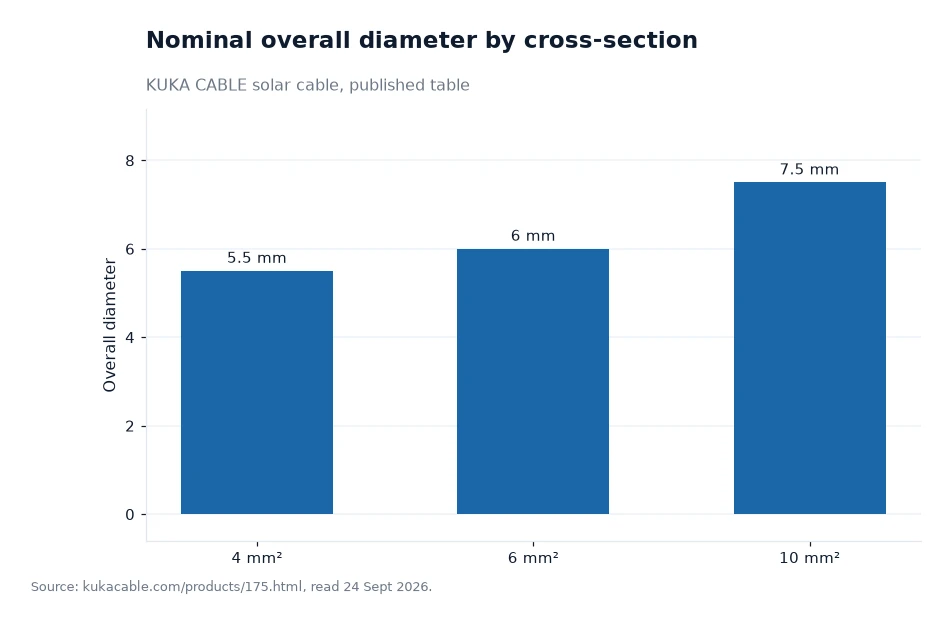
The weight per metre rises faster than the cross-section across the small sizes, because every size adds both copper and its share of the wall. At 1.5 mm² the published figure is 34 g/m and the diameter is 4.6 mm; at 2.5 mm² it is 45 g/m and 5.0 mm; at 4 mm², 59 g/m and 5.5 mm; at 6 mm², 78 g/m and 6.0 mm; at 10 mm², 130 g/m and 7.5 mm.
Two steps in that ladder deserve attention. Moving from 2.5 mm² to 4 mm² adds 14 g per metre, which is a third more material (14 divided by 45 is about 0.31; my own arithmetic), while moving from 6 mm² to 10 mm² adds 52 g per metre. The first step is the one a design takes when a string is marginally too long for the smaller size.
Why the strand diameter changes at 4 mm²
The published construction uses 0.25 mm strands in the two smallest sizes, 0.29 mm strands from 4 mm² to 70 mm², and 0.39 mm strands from 95 mm² upward. At 4 mm² the count is 56, at 6 mm² it is 84 and at 10 mm² it is 142, so the strand population grows with the copper rather than the strand size.
The site publishes the construction without explaining the choice, so a buyer who wants the reasoning should ask the manufacturer rather than infer it. What can be checked on paper is the flexibility class - class 5 to IEC 60228 - and the strand count for the size ordered, both of which appear in the table and both of which can be counted on a cut end.
Handling, bending and tray space
The diameter decides three practical things. The first is the minimum bend radius, published as 4 times the outer diameter, which is 22 mm at 5.5 mm (my own arithmetic). The second is tray fill, because the outside measurement rather than the conductor area sets how many cables sit side by side. The third is weight on a long pull, where 59 g per metre becomes 59 kg at a thousand metres.
The cables in this range are certified by TUV, IEC, CPR and others according to the manufacturer, whose solar cable section describes the construction behind those certificates, and the certificates page lists more than 30 certificate types including TUV, IEC, CE, SAA and UL. A product that has to be pulled through a duct or bent inside a roof void should be matched to that paperwork before the drum is opened, because a bend below the published radius is a mechanical failure rather than an electrical one.
| Nominal cross-section | Conductor construction | Nominal overall diameter | Nominal weight |
|---|---|---|---|
| 1.5 mm² | 39 strands of 0.25 mm | 4.6 mm | 34 g/m |
| 2.5 mm² | 49 strands of 0.25 mm | 5.0 mm | 45 g/m |
| 4 mm² | 56 strands of 0.29 mm | 5.5 mm | 59 g/m |
| 6 mm² | 84 strands of 0.29 mm | 6.0 mm | 78 g/m |
| 10 mm² | 142 strands of 0.29 mm | 7.5 mm | 130 g/m |
| 16 mm² | 238 strands of 0.29 mm | 8.8 mm | 190 g/m |
Worked example
Two calculations cover most of the handling question. First the weight: 1,000 m of 4 mm² at the published 59 g/m is 59 kg of cable (0.059 kg/m multiplied by 1,000 m equals 59 kg; my own arithmetic, assuming the published weight excludes the drum and the coil). The same length in 6 mm² is 78 kg and in 10 mm² is 130 kg, which is why long pulls are planned with the weight in mind rather than the cross-section alone.
Then the space: a 100 mm wide tray takes about 18 lengths of the 5.5 mm cable side by side before any clearance or derating is applied (100 divided by 5.5 is 18.2; my own arithmetic, assuming a single layer and no spacing allowance). With a 22 mm bend radius, each cable also needs a curved footprint of about 44 mm across at a 180-degree turn (2 multiplied by 22; my own arithmetic), so the last metre at a combiner is where the tray width is really decided.
Frequently asked questions
What does a metre of the 4 mm² cable weigh and how thick is it?
The published figures give the 4 mm² construction a nominal weight of 59 g/m and a nominal overall diameter of 5.5 mm, built from 56 strands of 0.29 mm of tinned copper with 0.7 mm of insulation and 0.8 mm of sheath. A 1,000 m length therefore weighs about 59 kg of cable (my own arithmetic, excluding the drum), and the minimum bend radius published at 4 times the diameter is 22 mm at that size.
Why does the 4 mm² use 0.29 mm strands instead of 0.25 mm?
The published table changes strand diameter at this size: 0.25 mm in the 1.5 mm² and 2.5 mm² constructions, 0.29 mm from 4 mm² to 70 mm², and 0.39 mm from 95 mm² upward. The site publishes the construction without explaining the reasoning behind the change, so a buyer who needs the engineering rationale should ask the product consultant. What can be verified is the class 5 flexibility to IEC 60228 and the strand count for the size ordered.
Checking a delivered 4 mm² drum
Weigh a metre against the published 59 g/m, measure the diameter against 5.5 mm, count the strands on a cut end against the published 56, and read the wall thickness from the data sheet as 0.7 mm of insulation and 0.8 mm of sheath. Then file the certificate with the delivery note and note which standard it quotes. Those four checks take a few minutes and they turn a five-figure order into something a buyer can defend on paper.
The diameter and weight numbers quoted in this 4 mm² article come from the manufacturer's own site, reviewed 24 Sept 2026[1].