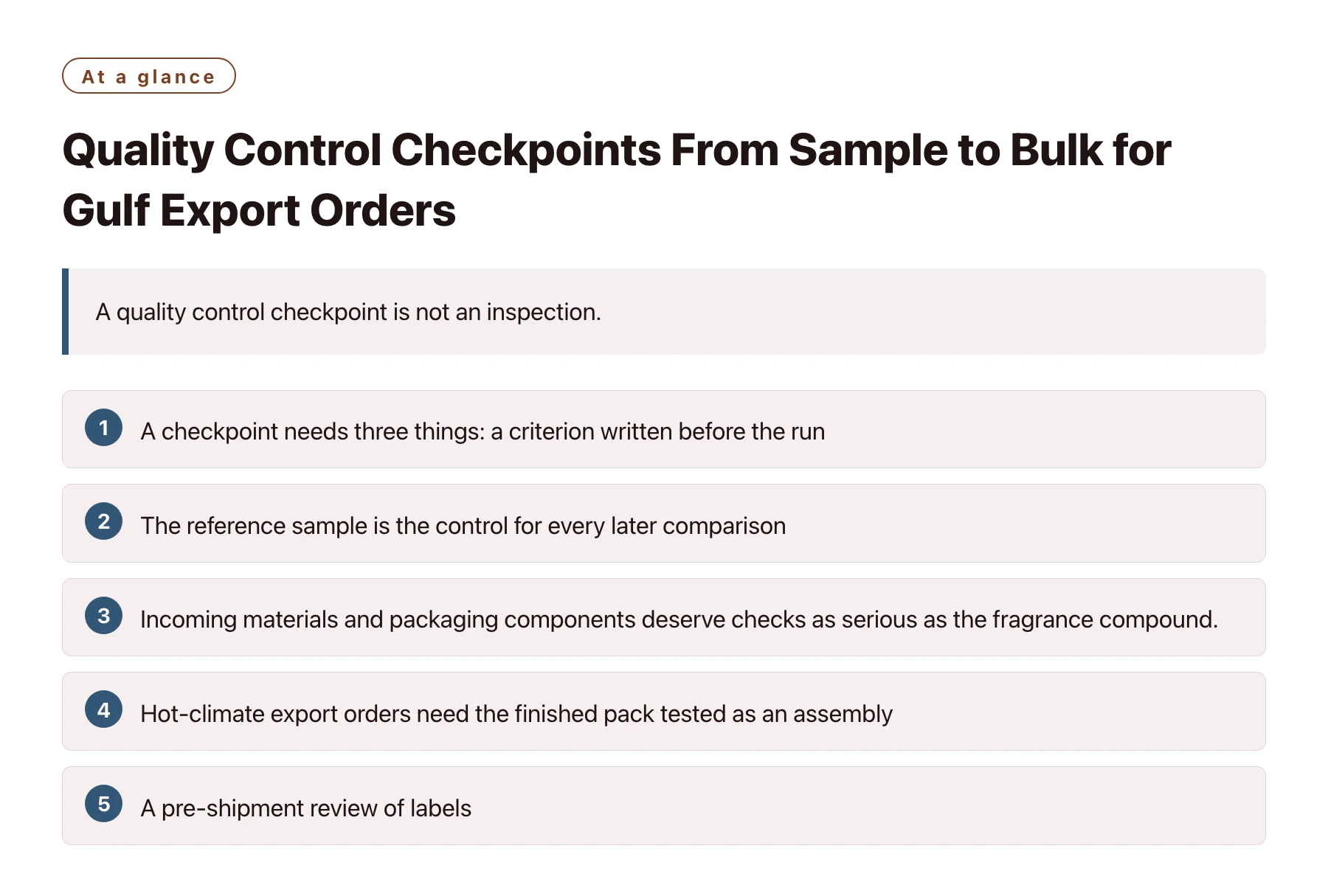
A quality control checkpoint is not an inspection. It is a decision point with a written accept criterion, a named owner and a record that survives the project. Inspections happen; checkpoints decide. Projects that scale cleanly from an approved sample to a bulk order are usually the ones where eight such decision points were agreed in advance, each with a clear answer to the question of who can stop the line and on what grounds.
Key takeaways
- A checkpoint needs three things: a criterion written before the run, a person authorised to act on it, and a record kept afterwards.
- The reference sample is the control for every later comparison, so it must be sealed, identified and held by both parties.
- Incoming materials and packaging components deserve checks as serious as the fragrance compound.
- Hot-climate export orders need the finished pack tested as an assembly, not only the liquid inside it.
- A pre-shipment review of labels, cartons and documents catches problems that no laboratory test will find.
Quality problems rarely appear as a dramatic failure. They appear as drift: a fill weight that moves slightly, a cap torqued a little tighter, a print registration that shifts on a carton, a bulk batch that is close to the reference without matching it. Each one is small enough to pass an informal look and large enough to trigger complaints at retail.
The purpose of a gate is to catch drift while it is still correctable. That requires the criterion to exist before the run, because a limit invented after a problem appears becomes a negotiation rather than a standard.
The sequence below follows a typical export order from formula freeze to shipment. It applies to any market; the final section covers the checks that hot-climate destinations make more important.
The eight gates from approved sample to shipped pallet
- Gate 1: formula and specification freezeThe formula, fill weight, concentration, carrier and packaging components are fixed in a signed specification, and a reference sample is sealed against it. Note which materials carry use restrictions and how much headroom remains, because that note governs any later change [1].
- Gate 2: incoming material checkFragrance compound, alcohol, closures, glass and cartons are verified against specification on receipt, with supplier documentation reviewed rather than filed unread.
- Gate 3: bulk compounding checkBatch records confirm weights, mixing sequence and parameters, and the batch is compared with the reference before it moves to filling.
- Gate 4: pre-fill checkThe rested bulk is assessed for appearance and odour profile against the reference, with a documented decision on whether it is released for filling or held.
- Gate 5: in-line filling checkFill weight, crimp or torque, spray performance and leak behaviour are checked at defined intervals during the run rather than only at the start.
- Gate 6: decorated pack and first-article checkAssembled units are compared against the approved proof: print registration, coating coverage, cap fit, pump function and carton closure.
- Gate 7: finished goods and retained sample releaseThe finished batch is compared with the sealed reference, and retained units are sealed and identified before the pallet is released for packing. Where external testing is used, the report should state parameters and conditions rather than only a pass result [2].
- Gate 8: pre-shipment reviewLabels, carton copy, batch coding and the document set are checked against the approved artwork and the importer's requirement list before the container is loaded.
What turns an inspection into a checkpoint
The difference is documentation. An inspection that ends with a nod leaves no trace, so the same question has to be re-argued at the next batch. A checkpoint ends with a record that says what was checked, against what limit, by whom and with what outcome. It is also the fastest way to judge a candidate supplier: ask a Chinese factory for perfume brands to walk through a single gate and show whether that record actually exists.
That record is also what makes a quality system auditable. A manufacturing practice aligned with a recognised cosmetic GMP framework such as ISO 22716 is essentially a promise that these records exist and are used [3], and the practical test of the promise is whether the records can be produced for a batch that shipped last month.
Criteria written before the run
Every gate should have a criterion on paper before production starts: a fill weight tolerance, a leak acceptance definition, a colour reference, a torque range. Criteria invented after a problem appears are not standards; they are compromises with a problem already attached.
A named owner with authority to stop
Someone must be able to hold a batch without asking permission from a sales team. In practice this is the single strongest signal of whether quality control is independent inside a factory, and it is worth asking directly during supplier evaluation, because the answer is verifiable.
A deviation process that leaves a trail
Batches that fail a gate should be held with a recorded reason and a decision: rework, reject or accept with a documented concession. A supplier that cannot describe this process is likely to resolve problems informally, which is comfortable until the first complaint arrives from a retailer.
The checks a hot-climate export adds
Orders shipped to the Gulf spend weeks in high temperatures on the way and in storage afterwards. That does not change the principle of the gates; it changes what a few of them must cover.
It is also worth asking how a candidate supplier describes the finished-product side of its work, because the checks around safety testing in perfume manufacturing and labelling are the ones that carry across every gate above. A supplier that treats those checks as a separate service rather than part of the production sequence is likely to hand them off at the point where a problem is cheapest to catch.
Test the pack, not only the juice
Adhesives, coatings, print and closures can all change behaviour after heat exposure, and the interaction between components matters as much as each component alone. The meaningful test assembles the finished pack exactly as it will ship.
Verify labels against the approved artwork
A label check is not a spelling test. It verifies that the shipped unit carries the approved artwork version, the correct language set, the batch code and any market-specific statements the importer requested. This is the gate that catches problems no laboratory can.
Retain units for the whole transit period
Retained samples are more valuable when they are stored under conditions similar to the shipment. A unit kept in an air-conditioned office proves less than a unit kept beside the pallet, and the comparison that matters is the one run after arrival.
Before the first order, ask the supplier to map its own gates: what is checked, against what limit, by whom, and what happens when a check fails. A supplier that can describe its gates can usually defend them; one that cannot will discover its process at the same moment you do. That conversation is also a fair test of fragrance manufacturing services in China more broadly, because the answers differ between suppliers and the difference is visible before any money moves.
Sources
- IFRA Standards Library (International Fragrance Association) —— The IFRA Standards Library lists the restrictions the fragrance industry applies to individual fragrance ingredients, based on safety assessments; it is the reference point for compliant fragrance formulation.
- SGS: Cosmetics, Personal Care & Household Testing —— Testing, inspection and certification services for cosmetics and personal care, including microbiological, stability and safety testing aligned with cosmetics GMP.
- ISO 22716 — Cosmetics Good Manufacturing Practices (GMP)
Frequently asked questions
How many quality checks should a first bulk order have?
Enough to cover the points where the product can change: materials in, compounding, pre-fill, filling, assembled pack, released batch and pre-shipment review. The number matters less than whether each check has a criterion, an owner and a record.
What should the retained sample be compared against?
The sealed reference sample approved before production, held by both parties and identified in the specification. Comparisons against memory or against a photograph are not comparisons.
Is third-party inspection worth it on a first order?
It can be useful for specific gates, particularly pre-shipment review and decorated pack checks, where an independent eye adds credibility. It complements rather than replaces the supplier's own records, which is why both should be requested.
How do we handle a bulk batch that does not match the reference?
Through the deviation process agreed before production: hold the batch, record the difference, and choose rework, rejection or documented acceptance. The remedy should be written into the agreement so the decision is about the product rather than about goodwill.
Do Gulf orders need different QC from European orders?
The gates are the same, but heat and transit make packaging and retention checks more important, and labelling verification often involves a second language. Adjusting the emphasis rather than building a separate system is usually sufficient.